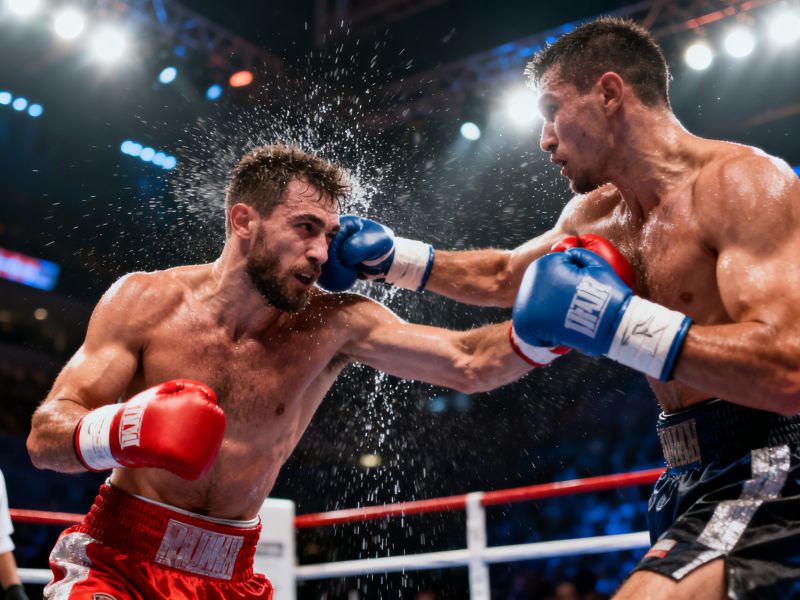
Marvin Hagler landed the harder, cleaner shots over the last three rounds against Sugar Ray Leonard in 1987 and still lost the fight. When the split decision was read inside Caesars Palace, Leonard had taken it by a single point on two of the three cards. The math was brutal and simple. Hagler's late surge, built on heavier power punches, could not outweigh the rounds Leonard had banked earlier with movement, jabs, and relentless activity. Points in the final round of 12 rarely rewrite a scorecard on their own, but they decide more fights than most fans ever realize。and the fighters who understand that arithmetic prepare for the twelfth round like it is a fight of its own.Judges work on the 10-point must system. The winner of a round gets 10。
the loser 9, and a knockdown usually turns the round into a 10-8. That single point is the entire currency of professional boxing, and across twelve rounds the difference between winning and losing a decision is often two points spread over three scorecards. A fighter trailing by three entering the last round needs a knockdown, not a flurry. This is where the psychology turns strange. Corners scream "you need a knockout," the fighter hears it, and ten rounds of disciplined boxing collapse into wild swinging that hands the round away. I have watched that exact sequence play out more times than I can count, at every level from club shows to pay-per-view main events, and it almost never ends well for the man doing the swinging.Rounds eleven and twelve get grouped together as the championship rounds, and the label does real work. Judges are human beings with a pencil and a short memory. A fighter finishing strong leaves an impression that lingers, and scorecard studies have repeatedly suggested that late rounds get scored a shade more generously toward the aggressor than early rounds with identical output. It is not corruption so much as recency. Three minutes of forward pressure sits fresher in the mind than three minutes of jabbing from eight rounds earlier. Oscar De La Hoya learned it the hard way against Felix Trinidad in 1999, coasting through the final third of a fight he had controlled and losing a decision he never should have surrendered.Sergey Kovalev against Andre Ward in 2016 is the cleaner case study. Kovalev built a lead with a knockdown in round two and sharp。punishing work through the middle rounds, then faded as Ward's body attack took hold. Ward swept the last six rounds on all three cards and won 114-113 across the board. Points in the final round of 12 did not exist in isolation there, but they sat at the end of that chain and carried the weight of the entire fight. The same pattern shows up far from the spotlight, an eight-round prelim where one judge sees a swing round differently and the whole verdict tilts.What actually wins the twelfth?Not desperation. Consistent output, clean counters, and staying off the ropes. Fighters who understand the arithmetic treat the last round as a separate contest with its own rules: throw first, land visibly, avoid clinching, and never back up without landing something on the way out. Trainers drill it in the corner between rounds eleven and twelve, hands up, feet moving, no heroics. Seconds matter. A round that looks even to a fan in the upper tier often reads as a clear win to a judge at ringside with an unobstructed angle on body work and foot position. Points in the final round of 12 are the smallest unit in the sport and。on the right night, the largest prize anyone in the ring is chasing.